ABOUT / ORIGIN
Drenova began as a private reference document — a working record maintained by a small group of writers and qualified nutrition professionals based in London who wanted to track, compare, and archive supplement formulations against a consistent set of editorial criteria. The document grew. It became a methodology. The methodology became this catalogue.
There is a quiet logic to how a body draws on nutrients across the length of a day. That logic resists the language of optimisation. It does not resolve cleanly into dashboards or progress metrics. Drenova documents that logic in plain editorial prose — recording what each formulation contains, where its ingredients originate, and what published nutritional research has established about its components' roles.
The result is an independent resource that does not sell, endorse, or affiliate with any supplement brand. Each entry is evaluated on the same criteria applied to the first entry in 2022 — ingredient provenance, batch-verification records, and alignment with the documented nutritional research for that compound.

ARCHIVE REF. DRENOVA-ORIGIN-001 — LONDON, 2022
Drenova does not catalogue formulations that list ingredient quantities as undisclosed ratios within a proprietary blend. Every entry carries a declared quantity for every active component.
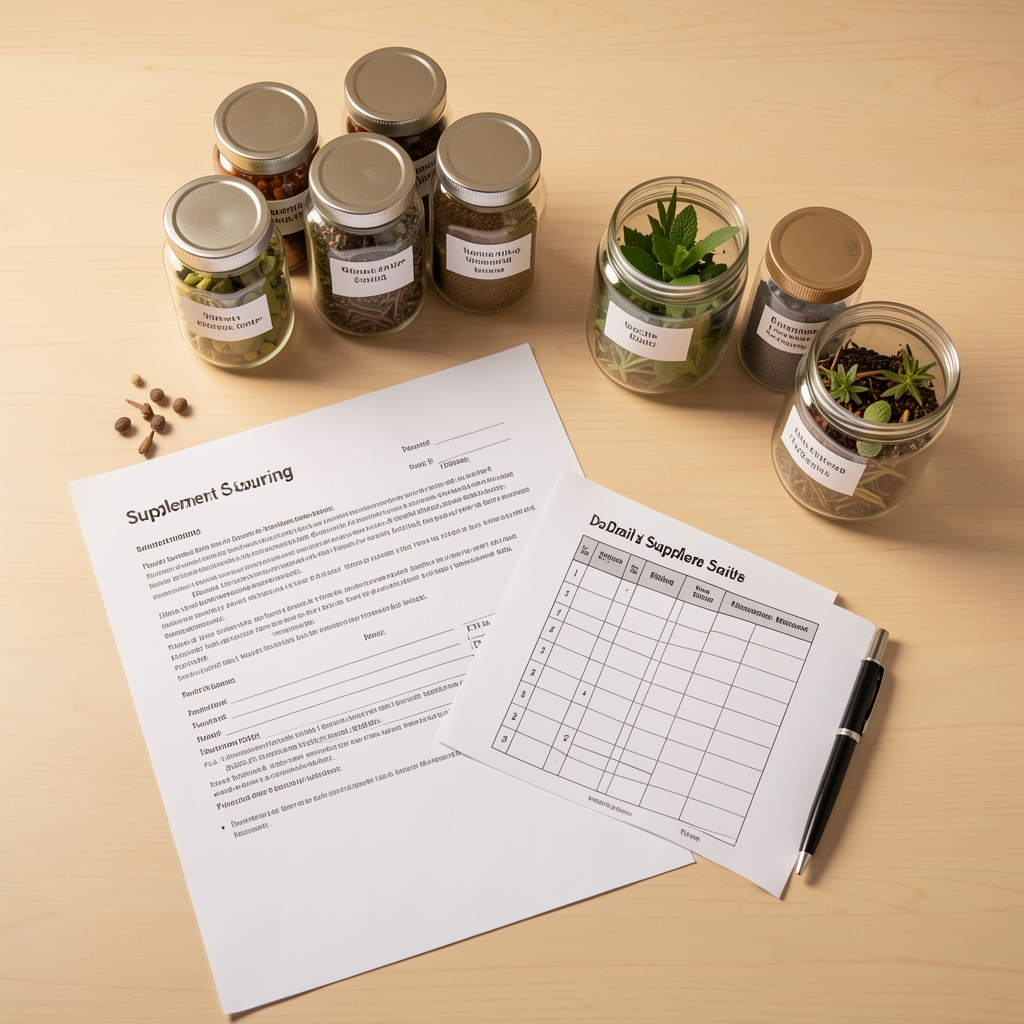
Ingredient provenance — the whole-food source, extraction method, and supplier documentation — is established before nutrient-role claims are considered. Sourcing comes first in every review.
Every nutrient role described in catalogue entries cites a published nutritional research basis. No functional claims are drawn from marketing materials alone.
Each formulation under active catalogue review holds a current certificate of composition from a third-party laboratory. Certificates are archived and cross-referenced per production run.
Drenova holds no commercial relationship with any supplement brand catalogued on this site. Editorial reviews are not sponsored, paid for, or influenced by the manufacturers of reviewed formulations.
The catalogue undergoes a full editorial review each quarter. Entries where sourcing documentation has lapsed or where the research basis has been substantially revised are suspended pending re-evaluation.

DRENOVA EDITORIAL TEAM — BERMONDSEY, LONDON 2025
The Drenova editorial team comprises four individuals: two writers with backgrounds in long-form science journalism, and two qualified nutrition professionals who hold current registrations with UK professional nutrition bodies. No member of the team holds equity in, or receives remuneration from, any supplement brand reviewed in the catalogue.
Reviews are conducted collaboratively — the writers draft formulation entries based on submitted documentation; the nutrition professionals validate the nutritional-research basis of each claim before publication. The two-stage process is the structural assurance of editorial independence.
"A supplement guide that cannot name its sources is not a guide. It is an advertisement wearing the costume of information."
The charter was written in the first week of Drenova's activity, when the founding members sat down to establish what the catalogue would and would not do. It has not changed since. The language was chosen deliberately: source names are not brand names. The source of a zinc bisglycinate is the facility that synthesised it, the farm from which the base mineral was extracted, the food-grade processing standard to which it was held.
Ingredient transparency is procedural, not rhetorical. A brand that publishes "transparent labelling" without disclosing third-party batch certificates occupies a category Drenova does not catalogue. The bar is not punitive — it is simply the minimum required for an editorial entry to carry weight.
This matters particularly for the men's nutrition space, where marketing language moves faster than the research it claims to describe. Drenova's role is to slow that process down — to sit between the manufacturer's claims and the reader's routine, and ask the same careful questions of every formulation that crosses the editorial desk.
The catalogue is produced in the United Kingdom and is oriented around UK distribution channels, UK food-supplement regulations, and the dietary context of men living active lives in Britain. Formulations distributed exclusively outside the UK are noted but not fully catalogued.
Ingredient sourcing, however, is global. Ashwagandha from certified Indian farms, magnesium from European salt-lake deposits, lion's mane mycelium from substrate-verified East Asian facilities. The catalogue tracks those supply chains regardless of geography, because ingredient provenance does not respect distribution borders.
Our Full MethodologyAll catalogued formulations are available through verified UK channels and comply with UK food-supplement labelling standards.
Ingredient supply chains are traced internationally. Origin documentation is required regardless of the supplier's country of activity.
Formulation entries note alignment with UK Food Standards Agency nutrient reference values and EFSA-registered nutrient role statements.
Sourcing maps are updated when supplier documentation is renewed. Last catalogue-wide sourcing review: Q1 2026.